Monday, March 21, 2022

Thinking About Thrips in 2022

Insect management is different from all other aspects of cotton production. With most insect pests, the situation changes year to year, week to week, and sometimes field to field. However, one insect that we can plan on being a consistent threat every year is thrips. This pest will infest 100% of the cotton planted in Alabama every year. What we cannot always predict, however, is when thrips pressure will peak. In a “normal” year in Alabama, we expect thrips pressure to be worse on early planted cotton and to be less later in the planting window as weather conditions improve. In 2021, this was not the case. Spring rains kept weedy hosts viable for a longer period, resulting in thrips pressure being the greatest on cotton planted after the middle of May. Much of our cotton was planted in this window and nearly 75% of our acres required a foliar treatment to supplement at-plant insecticides.

We have several options for at-plant management of thrips including insecticide seed treatments, and in-furrow liquid or granular materials. There are pro’s and cons of each approach, so deciding which strategy to use may make sense for one situation and not for another.


At-Plant Insecticide Options

Insecticide seed treatments
(ISTs) are currently the industry standard for thrips control, due primarily to the ease of application. However, under certain conditions control is variable. If conditions are not conducive to seedling growth, particularly if nighttime temperatures are cool, seed treatments alone may not provide adequate control. Due to developing resistance, particularly to thiamethoxam, we recommend seed be treated with an imidacloprid based seed treatment. There are several brand names, and some include additional insecticides, but imidacloprid should be a component. Under light to moderate thrips pressure, ISTs may provide adequate control. Seed could also be treated with acephate (e.g., Orthene) or acephate could be added to imidacloprid, however in most cases a bag of over-treated cottonseed cannot be returned if not planted.

Liquid or granular in-furrow insecticide applications are another at-plant option to manage thrips. These can be used to replace or supplement an IST. In many cases, in-furrow applications provide better control of thrips, however using them requires extra equipment, proper calibration and time when planting. Imidacloprid at the highest labeled rate has consistently provided good results in our trials across Alabama in recent years. Acephate has provided more sporadic control, likely due to the wet springs we have faced over the past 2 years and leaching out the chemical before the roots can uptake the needed amount to provide control. Aldicarb, now available as AgLogic15G, is another in-furrow option. This granular product provides excellent control of thrips and provides control of nematodes as well. Keep in mind that aldicarb is a restricted use pesticide and additional training may be required to use this product.

Foliar Insecticides

Foliar insecticides may be needed to supplement at-plant treatments. However, foliar applications should never replace an at-plant insecticide. Thrips can injure seedling cotton until around the 5th true leaf stage. Research shows that foliar applications are usually most effective when made at the 1st true leaf stage. The Thrips Infestation Predictor for Cotton is a reliable tool that predicts the relative risk of thrips injury for cotton planted at a given location and planting date. To maximize the accuracy of the model, it should be run for several days before and after planting, as unpredicted weather patterns may alter the prediction. This tool should not be used to determine planting dates, but rather to help plan out fields or planting dates for cotton that will likely need a supplemental foliar application. Several options are available to use to supplement at-plant insecticides.

·         Acephate (3 oz/A) is an effective and relatively inexpensive option, however it has the potential to flare secondary pests such as spider mites and is the least rainfast of the available recommended options.

·         Bidrin (3.2 oz/A) is another option that is effective and less likely to flare spider mites and is more rainfast than acephate, however it is more likely to cause crop injury when tank-mixed with herbicides.

·         Dimethoate (6.4 oz/A) is another cost effective and efficacious product with good rainfastness, however it is the most likely to cause crop injury when tank-mixed with herbicides.

·         Intrepid Edge (3 oz/A) is another effective option. Intrepid Edge is less likely to flare secondary pests but may need the addition of a surfactant to help with efficacy.

·         Pyrethroids are not effective and should not be used to manage thrips.

Effective thrips control is critical to get the 2022 crop off to a good start. When considering areas to cutback on costs, do not skip out on at-plant (IST or in-furrow) insecticides. We cannot manage thrips without having protection for the seedlings as soon as they emerge. If planting into cool, wet conditions, be prepared to make supplemental foliar sprays to help seed treatments get seedlings to the 5th true leaf stage. More information about thrips can be found in Pests of Alabama Cotton: Thrips (ANR-2718). For more information on thresholds and insecticide recommendations, visit the Alabama Cotton IPM Guide (IPM-0415). To stay up-to-date on the Alabama cotton insect situation, subscribe to the Alabama Cotton Shorts Newsletter, Alabama Crops Report Newsletter and Podcast, and the Syngenta Pest Patrol Hotline.

Tuesday, March 8, 2022

What Did We Learn about Cotton Insect Management in 2021?

Several cotton insects presented unique or unusual infestation patterns in 2021. The following is a discussion of insects as they occurred during the season and what we may want to consider as we enter the 2022 crop year.

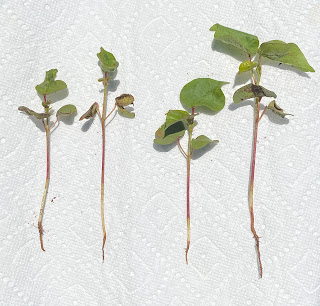
Cotton seedlings showing varying thrips injury in 2021.
Thrips, for the second season in a row, reached their peak injury period in late May to early June. Therefore, the heaviest damage was to cotton planted after about May 10-15. Growers should be alert and protect all seedlings from thrips injury until plants reach about the 5th true leaf. This can be done by applying a timely foliar spray when seedlings are at the 1st true leaf. The Thrips Predictor Model, developed by NC State with research data from all Southeastern states, is very useful in alerting to potential injury in this late planting window, especially when it is run weekly until all seedlings are safe from injury. This phenomenon of thrips damage on late planted cotton is likely driven by frequent rainfall in the early to mid-planting window. Excessive rainfall tends to sustain and keep lush wild host plants that harbor thrips, thus delaying their movement to cotton.

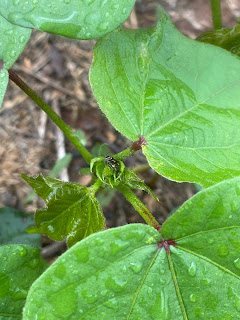
Plant bug infesting 7 node cotton in Belle Mina, AL in 2021
A second pest that presented an unusual infestation pattern last year was tarnished plant bug. A heavy, statewide movement of adult plant bugs from wild hosts to cotton occurred between June 13-15. Reports and observations about plant bug migration came from Central Alabama, Tennessee Valley, Gulf Coast and Wiregrass during this 72-hour period. This movement, had it been from one specific area, would have been expected, but the fact that it occurred statewide within a short time had never before been observed or reported. All available media, social, electronic and telephone hotline, were employed to alert agents, field advisors and farmers. These early season adult plant bugs immediately began feeding in young squaring cotton, causing pinhead square loss in the early fruiting window. At the same time, female adults were depositing eggs into the tender stems of cotton, producing a hatch of immature plant bugs 3 weeks later in cotton between weeks 1 and 3 of bloom. Where timely controls were not made, “dirty” blooms resulted, and yields were reduced.

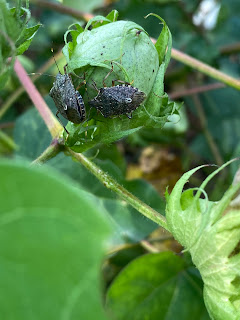
Stink bugs can cause damage until bolls are ~25 days old.
One other insect, stink bugs, should be part of this discussion. Stink bugs were more numerous than expected last season following what we thought was a colder than normal winter, including a particularly cold week that occurred in mid-February. We realize that though stink bugs have been our number one most damaging insect in cotton for the past 25 years, we are still refining or fine tuning our control strategies. One observation made in 2021 was that mid to full season varieties may require an additional late season application as compared to early maturing varieties. Basically, stink bug controls are warranted until the uppermost bolls – top bolls that are expected to be harvested – are about 25 days old and hard to the touch. During boll fill, a stink bug application should give about 2 weeks control or suppression except in field borders adjacent to corn, peanuts, pecans or other alternate stink bug hosts. After stink bugs enter cotton, beginning about the 3rd week of bloom, any applications targeting plant bugs should include an insecticide or tank mixture that controls both pests.

Take Home Point:


The take home message from these occurrences is that growers and other ag advisors must be aware of more than just what they see in local fields. They must be “in the loop” from a bigger perspective in order to be alerted to unusual insect outbreaks. The Alabama Extension Cotton Entomology team has lots of eyes and ears throughout the state and receive daily and weekly feedback that can be passed along to all involved.

Ways to stay in the loop:

Syngenta Pest Patrol Hotline

Alabama Crops Report Newsletter and Podcast

Alabama Cotton Shorts Newsletter

AgFax Seasonal Crop Reports (Subscribe to Southeast Cotton)


Thursday, October 14, 2021

Summary of the 2021 Alabama Cotton Insect Situation

 They always say, “there are no two growing seasons alike,” and 2021 was no exception. Spring rains across much of Alabama pushed back planting, causing a lot of “late” cotton. Several storms also moved through later in the year causing headaches across different regions of Alabama. Even with all the issues we have had, we still have good yield prospects this year. Hopefully we will have a cooperative finish to the harvest season and be able to get everything out in a timely and efficient manner.

Like last year, insects were not a major limiting factor. This is largely due to good scouting and timely insecticide applications when needed. Starting at burndown and going through to the end of bloom, several insects required monitoring and treatment. Walking back through the season, here is a look at what was observed and experienced.

Grasshoppers caused concern on a large percentage (60%) of acres statewide, primarily across central and south Alabama, and particularly on our sandier soils. Most of these fields were in reduced or no-till systems and required an insecticide at burndown or at-planting to mitigate risk of stand loss from this pest. In general, grasshoppers were managed effectively and little or no loss is expected from them. In a “normal” year, we would have expected thrips pressure to be relatively light due to the high percentage of cotton planted late. However, as experienced last year, late planted cotton experienced significant thrips pressure. The majority of the acres needed a foliar insecticide to supplement seed treatments, and most of those acres received one. The emerging mollusk pests (slugs and snails) also caused issues. Slugs are always a concern in cool, wet years and in high residue fields. Snails were a particular problem in several fields in Southeast Alabama. We currently have limited options for slugs and no options for snails (outside of tillage). These pests caused some replanting in spots this year.


The tarnished plant bug was the pest that caused the most headaches for pest management decision makers in 2021. Within a 4-5 day stretch in mid-June, a major plant bug migration occurred statewide. This is was a rare event, as normally plant bugs move from spring hosts to cotton at different times in the north and south. This mass migration was further complicated by the overall lateness of the crop. Adult plant bugs primarily infested the earliest planted (most mature) fields that were just beginning to develop pinhead squares (a small proportion of the overall crop). Plant bugs began feeding on these pinhead squares and laying eggs that developed into an embedded population of immatures in July. With much higher than “normal” populations in fields statewide, the plant bug issues never played out as we are used to.

In addition to tarnished plant bugs, the clouded plant bug was also found in many fields across central and south Alabama. While not at treatable levels alone, this pest drove insecticide selection decisions in several fields. Many fields at peak bloom, requiring sprays for stink bugs, still required scouting and treatment for plant bugs. Overall, stink bugs were at high numbers statewide, including the Tennessee Valley, where stink bugs are historically considered a sporadic pest. Many fields across Alabama required 4 or more sprays for the bug complex this year. In many cases, proximity to corn appeared to play a key role in the overall pressure of the bug complex in cotton.

Other secondary pests, such as spider mites and aphids were in fields and required attention at times, but overall were light statewide this year. Similarly, Alabama cotton experienced a light bollworm year. Although some of our traps caught high numbers of moths at the peak flight, we did not receive reports or observe escaped bollworms or significant damage from worms. As has been observed for several years, the 2- and 3-gene Bt varieties provide very good control of bollworms in Alabama.

As we prepare to move into the 2022 planning season, it is important to think back through what happened in 2021 and try tweak our pest management plans to continue to effectively manage and keep losses to insect pests low.


Friday, August 13, 2021

Alabama Cotton Insect Situation August 13, 2021

As the calendar turns to August the Alabama Cotton Insect Situation has really started to heat up. Plant bugs are still heavy in spots statewide, but stink bugs are becoming more and more of an issue as the crop continues to bloom. Some heavy bollworm egg lays have also been reported in parts of the Tennessee Valley. The overarching theme with many of these pests appears to be the drawn-out planting of corn due to wet weather this spring. Insect pests continue to trickle out of corn as the migrate into cotton fields. Spider mites are also in fields and have reached treatment levels over the past few days as well.

Plant Bugs

Plant bugs (tarnished and clouded) are still requiring treatments in some fields in Central and South Alabama. Cotton in the Tennessee Valley is under pretty substantial plant bug pressure. As we are now blooming, the black drop cloth is the preferred method to scout for plant bugs. Threshold is 3 tarnished plant bugs per 5 row feet. If clouded plant bugs are found, they should be counted as 1.5 tarnished plant bugs. Keep in mind that clouded plant bugs tend to do a little more damage to small bolls than tarnished plant bugs, thus the change in threshold.

Immature Clouded Plant Bug
Immature Tarnished Plant Bug


Stink Bugs

Adult Green Stink Bug
Thus far, stink bug pressure seems to be higher than normal. This is especially true in the Tennessee Valley. In fields where no controls with activity on stink bugs have been sprayed, stink bug pressure (and damage) has been quite high. Stink bugs are a consistent threat to cotton in central and south Alabama, so more controls with activity are used to stink bugs are used when spraying plant bugs. The most reliable method to scout for stink bugs is to sample bolls about 1 inch in diameter for internal sings of injury (pin-prick marks, warts or stained lint). Threshold is 10% internal injury from weeks 3-6 of bloom. Regardless of location in the state, if a “hard” chemistry has not been used by the 3rd week of bloom, I would highly recommend finding a reason to use one.

Bollworms

We received reports of heavy egg lays in the TN Valley this week. No reports of escaped worms have been made (yet), but with 20%+ egg infested plants, there is a possibility. Outside of 2017, escaped worms have not been a big issue in Alabama but there can always be some fields that don’t go as planned. Aside from the terminals, bollworm moths seem to prefer to lay eggs on bloom tags (drying bloom petals). Thus, egg scouting efforts should be focused on in the terminals and the blooming zone (particularly on bloom tags). Currently, our recommended thresholds are based on the number of escaped worms found per 100 plants. Escaped worms may be found on bolls (often underneath the bloom tag), squares or white blooms. In Bollgard II and TwinLink technologies, escaped worms tend to be found in the blooming zone. Threshold is 5 worms (0.25 inches or bigger) per 100 plants. To date, we have seen no issues with 3 gene technologies (Bollgard 3, Widstrike 3, TwinLink Plus). We do not recommend treatment on these varieties.

Bollworm eggs on terminal.
Escaped worm feeding under
bloom tag.

Spider Mites

We have received reports of spider mites from the Wiregrass over the past week. Mites are in nearly every field statewide  at some level all year long waiting for a hot, dry stretch to “blow up.” As we write this, we don’t know what the incoming tropical storm system is going to do, but it looks likely rain events are coming. We do not know what that will do to spider mites approaching treatment levels currently, so making applications in front of the storm may be advisable. Treatment decisions require a bit of professional judgment. Threshold is when mites and their injury is widely distributed across the field. Coverage is critical for control of spider mites. Using the higher end of labeled rates is advisable as cotton is into bloom.

Parting Shots

We still have another 4-6 weeks left to make cotton in Alabama. Hopefully Tropical Storm Fred will bring some needed rain (but not too much). Keep scouting and spraying fields as needed. Up-to-date thresholds and insecticide recommendations visit the Alabama Cotton IPM Guide (IPM-0415). We will continue to put out information through twitter, this newsletter and the Alabama Crops Report Newsletter, Podcast and on the Pest Patrol Hotline. As always, if we can ever be of any help please don’t hesitate to let reach out.


Monday, July 12, 2021

Alabama Cotton Insect Situation July 12, 2021

 Tarnished Plant Bugs

Immature Tarnished Plant Bug
While the peak migration of tarnished plant bugs in central and south Alabama seems to be over, it appears to just be starting in the Tennessee Valley. We received reports and saw fields with 1-3x threshold populations (2 per 25 sweeps) of adult tarnished plant bugs last week (July 7). In almost every case, square retention was still high, which tells us that the plant bugs had just started moving in. As this newsletter is coming out, we suspect square retention will have significantly fallen if those fields were not treated. With the delays in finishing planting and differences in cotton maturity across the state, we will likely be managing plant bugs differently in individual fields this year.

In our most mature fields (those in bloom) we need to be sampling for immature plant bugs. This is done by placing a black drop cloth between two rows of cotton and shaking the vigorously the plants on either side of the cloth to dislodge any insects on the plants onto the cloth. Count the number of immature plant bugs on each sample. Threshold is when you find an average of 3 bugs per 5 row feet (one drop cloth sample).

Adult Tarnished Plant Bug
In our later planted cotton (prior to bloom), we are still looking for adult plant bugs migrating in. To scout for adults, the most efficient methods are to use a sweep-net and/or monitor square retention. To monitor square retention, look for the presence (or absence) of first position squares on the upper 2 or 3 nodes of the canopy. Threshold is when you find an average of 2 adults per 25 sweeps OR if square retention falls below 80%.  One thing to keep in mind when dealing with adult plant bugs is that NO product will provide much, if any, residual control. Adults may continue to infest fields after sprays, so if checking a field 7 days after an application, it may be possible to find the same number – or more – adult plant bugs than the previous week. This does not necessarily mean a control failure, just that more adults have moved into the field. As long as we are setting squares and square retention is above 80% then we know our application did its job.

Depending on the targeted populations, we have several options for control of plant bugs. When going after adults in pre-bloom cotton, the neonicotinoids provide adequate control of both plant bugs and aphids (e.g. imidacloprid, Centric). When primarily dealing with immature plant bugs in blooming cotton, we tend to shift away from the neonics to other chemistries. The insect growth regulator, Diamond, is a good option that provides 2-3 weeks residual control when used at a rate of 6-9 oz, respectively. Diamond should be combined with a knockdown insecticide such as Transform, acephate, Bidrin or pyrethroids (depending on resistance levels in your area) to provide more immediate control.

Stink Bugs

Smaller boll damaged
by stink bugs
As some of our most mature fields are at the first couple of weeks of bloom, it is time to start thinking about stink bugs as well. We know that stink bugs are seed feeders and prefer bolls that are around 10 days old (about the diameter of a quarter), however in a situation with few of these bolls present, stink bugs will feed on even smaller bolls. Don’t slack up on sampling bolls for damage in these earliest fields. Remember that sweep-nets and drop cloths are not an effective way to scout for stink bugs. In order to scout for stink bugs we have to sample for internal boll damage by cracking bolls open and looking for signs of stink bug feeding (warts, pin-prick marks, stained lint). The threshold during the first two weeks of bloom is 30-50% internal damage and 10% for weeks 3-6. In a “normal” year, we don’t worry as much about damage during the first 2 weeks of bloom, because there are fewer bolls at risk during this time. However, this year with fewer acres in the area blooming and setting bolls at this point, we have the same number of stink bugs with less acres of cotton to dilute the population. Thus, stink bugs may be in more concentrated numbers in fields in our most mature cotton than “normal” this year. Be sure to look at small bolls during this time while still scouting for plant bugs. Stink bugs tend to infest field borders (50 feet) and smaller fields (20 acres) more heavily so keep that in mind when scouting.

Aphids and Spider Mites

We have received reports of the aphid fungus killing aphids in parts of South Alabama over the past week. Hopefully the fungus will spread statewide quickly and knockout any lingering populations we are dealing with from now on. We have also gotten reports of spider mites in fields in the east central and southeast areas of the state. For now, we are advising folks to watch the populations and wait until the forecast shows a several of hot, dry days in a row before spraying. We want to maximize the effectiveness of the application and reduce the chances of a rain event reducing efficacy.

Take Home Message for the Current Cotton Insect Situation

With the varying stages of cotton (from 1st true leaf to 3rd week of bloom) across the state (and within an individual farm in some cases) we are going to have to do a lot of insect management on a field-to-field basis in 2021. Proper scouting and keying in on the correct pest for the stage of crop and time of year will be critical. We will continue to put out information through twitter, this newsletter and the Alabama Crops Report Newsletter, Podcast and on the Pest Patrol Hotline. As always, if we can ever be of any help please don’t hesitate to let reach out.
Wednesday, June 16, 2021

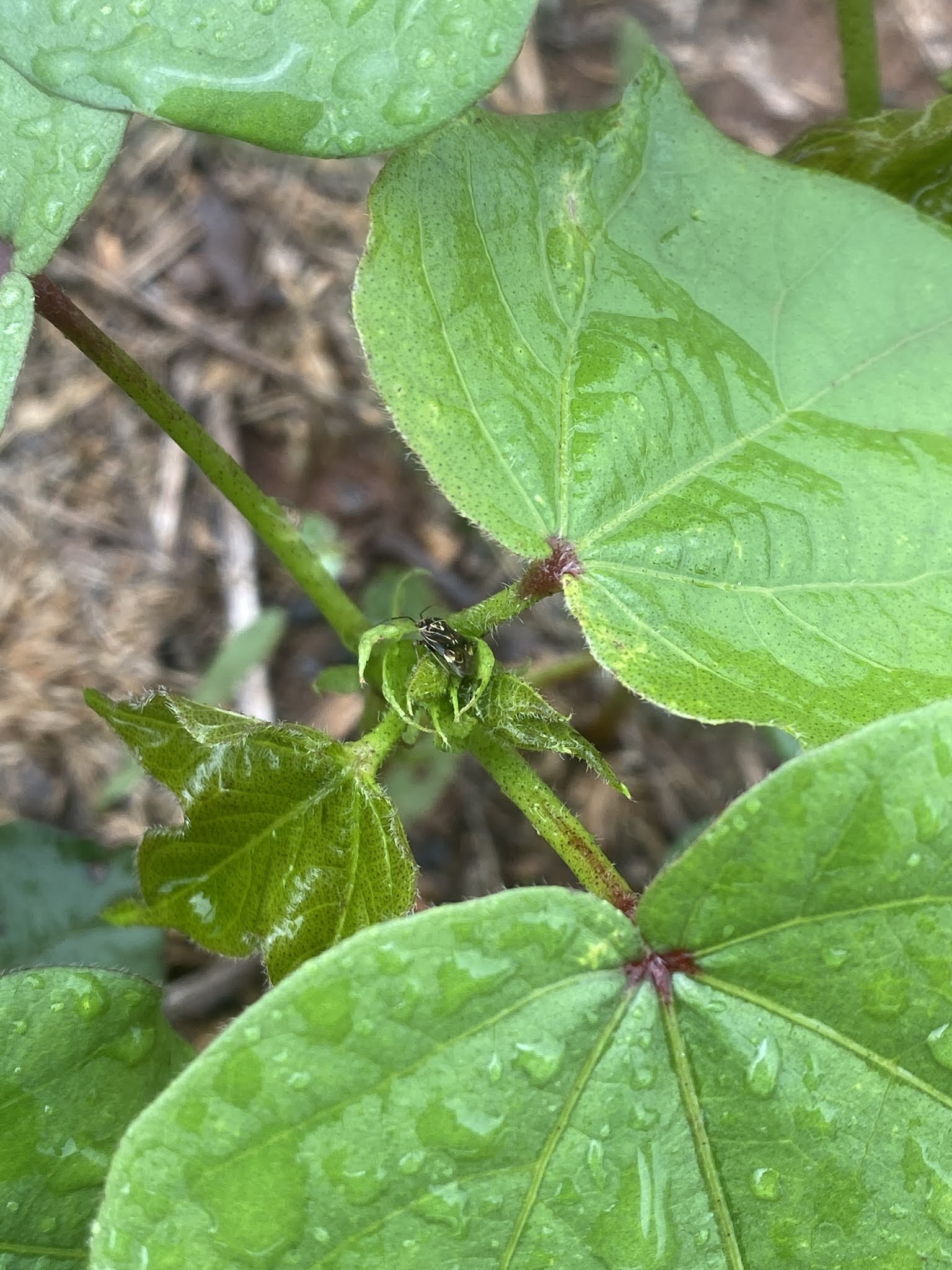
Tarnished Plant Bugs on the Move in Alabama

Over the past few days, we have been hearing reports and have seen infestations of tarnished plant bugs 
infesting cotton fields across Alabama, from the Florida line, through central Alabama up to the Tennessee Valley. In some cases, cotton is older (up to 12 nodes) but in many fields the cotton is just starting to put on pinhead squares (7-8 nodes). The one thing all of the fields have in common is that is the most mature cotton in the area. These are the fields we need to be keying in on when scouting. It will be important to scout with a sweep-net (TH= 2 adults per 25 sweeps) and monitor pinhead square retention in the upper 2-3 nodes (maintain 80% of first position squares). Depending on timing, we may see high plant bug numbers and good square retention. However, this could likely be because plant bugs had just moved in and squares that have been fed on have not yet had time to show symptoms. Thus, if either threshold hits, action should be taken. Keep in mind that thresholds aren’t always a “cut and dried” number. If the sprayer won’t be back in an area for 7-10 days and square retention is approaching (but above) 80% with plant bugs present, treatment may be warranted. Sometimes making the call requires some professional judgement based on previous experiences. We filmed a video with more info on plant bugs with Eddie McGriff last year (link).


Based on our sampling of wild hosts (daisy fleabane),
it is likely that we see an extended migration of adult plant bugs over the next few weeks. This gives us the potential to need multiple applications to control adult plant bugs pre-bloom. If this is the case, it will be even more important to monitor square retention. Sometimes following up on an insecticide application can be tricky. We may scout a field 7 days after treatment only to find the same number of (or more) adult plant bugs in the field. This may not mean treatment failure, but that more bugs have migrated into the field. By monitoring square retention, we can check to see that the pinhead squares present at application were protected by the treatment.

Another thing to consider is that the adult plant bugs are also lay eggs and immature plant bugs will start showing up just prior to or at first bloom. Action taken on this migrating population of adult plant bugs can help to reduce future populations of immature plant bugs later in the year.

With good cotton prices and an already late crop, we need to be sure we are staying ahead of insect issues and avoiding any more delays in maturity or losses yield.

If anyone has any observations of plant bugs or any other pests infesting fields, please let myself (662-809-3368) or Ron (334-332-9501) know. We are always here to help.

Thursday, March 4, 2021

Thrips Management in Cotton for 2021

As the 2021 cotton production season approaches, it is time to start preparing for thrips management.

Thrips are the dominate insect pest of seedling cotton in Alabama. Each year, thrips infest 100% of the acres planted statewide. Due to this, thrips must be managed with an at-plant insecticide. We have several options for at-plant management including insecticide seed treatments (ISTs), and in-furrow liquid or granular materials. There are pro’s and cons of each approach, so deciding which strategy to use may make sense for one situation and not for another.

Insecticide Seed Treatments 

In recent years, the neonicotinoid insecticide seed treatments have begun to show reduced efficacy, particularly thiamethoxam. For this reason, we no longer recommend the use of thiamethoxam alone (e.g. Cruiser, Avicta) to manage thrips in cotton. If an IST is used, we recommend it be imidacloprid based. Examples of imidacloprid based ISTs include Gaucho and Aeris (imid. + thiodicarb). Although not bullet proof in all cases, these products typically provide adequate protection from thrips under light to moderate pressure. Another option would be to treat seed with acephate (e.g. Orthene) or to supplement an imidacloprid IST with an additional treatment of acephate. The only problem with this approach is that one a bag of cotton seed is opened and over-treated, it cannot be returned if not planted in most cases.


In-Furrow Insecticides

Another option is to use in-furrow insecticides to supplement or replace ISTs. In-furrow liquid applications of imidacloprid generally provide very good control of thrips. Acephate may also be used and provides good control under the right conditions. Acephate should not be used in place of an IST as it does not provide long residual control and may be leached out of the rootzone prior to plant uptake under cool, wet conditions. Another option is AgLogic (aldicarb). This granular product provides excellent control of thrips and can also be used to manage nematodes as well.

Foliar Insecticides

Foliar insecticide applications should be made to supplement at-plant thrips management, not be used as the “first line of defense.” Cotton is susceptible to thrips injury until around the 5th true leaf stage. Generally foliar applications are most effective when made at the 1-2 true leaf stage. The Thrips Infestation Predictor for Cotton can be used to show the relative risk of thrips injury for cotton planted at a given location and date. This can be used to help plan out fields or planting dates for cotton that will likely need a foliar application. Several options are available to use to supplement at-plant insecticides.

·         Acephate (4-6 oz/A) is an effective and relatively inexpensive option, however it has the potential to flare secondary pests such as spider mites and is the least rainfast of the available recommended options.

·         Bidrin (3.2 oz/A) is another option that is effective and less likely to flare spider mites and is more rainfast than acephate, however it is more likely to cause crop injury when tank-mixed with herbicides.

·         Dimethoate (6.4 oz/A) is another cost effective and efficacious product with good rainfastness, however it is the most likely to cause crop injury when tank-mixed with herbicides.

·         Intrepid Edge (3 oz/A) is another effective option. Intrepid Edge is less likely to flare secondary pests but may need the addition of a surfactant to help with efficacy.

·         Pyrethroids are not effective and should not be used to manage thrips.

In order to get the 2021 cotton crop off to the best start possible, at-plant thrips management is a must. Supplemental foliar sprays may be necessary in certain situations, particularly with earlier planted cotton when nighttime temperatures are cool. More information about thrips can be found in Pests of Alabama Cotton: Thrips (ANR-2718). For more information on thresholds and insecticide recommendations, visit the Alabama Cotton IPM Guide (IPM-0415). Results from 2020 cotton insect research trials can be found in 2020 IPM Projects Advancing Alabama Cotton Production (ANR-2735).