What are we currently finding in Alabama cotton fields? Plant bugs, both the tarnished and clouded species, have finally reached threshold or treatment levels in April planted fields that have not been sprayed. Some level of brown stink bugs can also be found in these same fields. A bug clean up spray would be advised for most cotton that is in the fourth or fifth week of bloom. Peak numbers of squares and bolls are currently at risk. Cotton planted after about May 10 missed most of the plant bugs this season. In central and south Alabama, there are very few plant bugs currently present in wild host or other crops. In other words, there are no more plant bugs in the landscape to migrate to cotton in 2017 in that region.
Between July 24 and 28, numerous field people from all areas of the state were contacted about escape bollworms on cotton with caterpillar technology. As of July 31, no none has reported any problems. We have conventional cotton on research stations in several areas of the state. Some level of bollworms and damage can be found on this cotton. The corn earworm flight from corn began about July 15 and has likely already peaked. Tobacco budworms will enter the mix during the month of August, but they will not be part of the "escape" situation in August. However, fieldmen should continue to monitor closely for escape bollworms. In Alabama, I would suggest we try the pyrethroid chemistry first if escapes are found.
Spider mites came into the picture about the third week of July in the Tenn. Valley area. Mites will likely show up in other fields statewide if we ever experience a 7-10 day period between rain events. Abamectin will provide the most economical control of mites. Whiteflies may occur in late season on our late maturing fields. If whiteflies are observed, I would recommend we use pyrethroid chemistry for stink bugs since Bidrin seems to aggravate the whitefly situation.
We will likely see stink bug numbers increase as we move into August and even September in our late maturing cotton. The southern green stink bug will make up a greater part of the population in coming weeks. This gives us the flexibility to choose either pyrethroid or phosphate chemistry. For weeks 3 through 6~7 of bloom, we recommend a 10% internal damage boll threshold for stink bugs.
Thus far in 2017, insects have not been a major limiting factor in Ala cotton production. Let's hope we can keep this trend going for several more weeks.
Showing posts with label Spider mites. Show all posts
Showing posts with label Spider mites. Show all posts
Monday, July 31, 2017
Monday, August 4, 2014
Update for the Week of August 4, 2014
The most significant insect event in the past week was the
reports of plant bug tolerance to all labeled or recommended insecticides in
the Tennessee Valley of North Alabama. Several of our most experienced
consultants are reporting that all classes of chemistry are suppressing plant
bugs but their presence and damage behind applications are still above
threshold levels. This has required repeated sprays and now tank mixtures with
two recommended insecticides. Under these conditions, input costs for cotton
insects, particularly plant bugs, make cotton an unattractive crop option going
into the 2015 season. Some areas of the mid-south have been dealing with this
problem for several years. At this point, the Alabama situation appears to be
confined to the Tennessee Valley area.
It has been my experience that once plant bugs get embedded
in rank cotton in July, they have always been difficult to control, requiring
multiple applications. So now, we have insecticide tolerance in addition to a
coverage issue. Looking ahead I see a larger role for the IGR Diamond during
the early bloom period in future years.
Now to a quick oversight of other insect problems on cotton
and other crops; stink bugs, primarily brown, are requiring controls in some
cotton fields. However, overall they are not as heavy and widespread as
expected. Aphids are showing back up in some fields requiring controls. Spider
mites are present in many fields. It seems like we get more calls about mite
control following weeks of high temperature and dry conditions.
In soybeans we are beginning to see loopers as far north as
Montgomery in older beans. So far they are only at about a third of a threshold
level. Scouts are reporting an occasional corn earworm and velvetbean
caterpillar in the soybean mix. The same holds true for peanuts.
Fall armyworms (grass strain) are on about every crop except
cotton now. Hay, grasses, peanuts, soybeans are all experiencing the need for
repeated applications for FAW. We could safely say that FAW’s have about worn
out their welcome, even though they are easy to control. It seems like their
preferred row crop is soybeans planted in wheat stubble. Some fields are now on
their third infestation and replanting has been required due to near 100%
defoliation.
In many ways, 2014 has been like “old times” to Extension
entomologists with numerous phone calls about when to treat and what chemical
to choose. We don’t feel like step-children to the weed resistance and disease
issues this season.
Scouting crops is the first step in all insect management
and control programs.


Monday, June 30, 2014
How to Control Spider Mite and Plant Bug Infestations
Additional reports of economic spider mite infestations
continue to come in, particularly from central and south Alabama. The heaviest
infestations are already causing significant leaf shed in early square cotton. Fieldmen
have reported that the lower leaves that show the greatest damage do not always
have high mite numbers. Mites will continue to move up the plant to fresher
leaves as the older leaves get ready to drop. Fieldmen should look a couple of
nodes above the most damaged leaves in order to get a good handle on the number
of mites present.
Several materials are recommended for mite control. However,
some of these materials only seem to work in some locations. Examples are:
bifenthrin, chlorpyriphos, dimethoate and propargite. One product in our 2014 recommendations
is no longer on the market – dicofol. That leaves the newer mite chemistry as
our best choice for control. These are abamectin (Agri-Mek), extoxazole (Zeal),
fenpyroximate (Portal), and spiromesifen (Oberon). Abamectin is the most
economical and has been the most widely selected for mite control. Ag suppliers
are encouraged to have some on inventory since spider mites appear to be a
growing problem.
Plant bugs continue to be reported in cotton that is
squaring or approaching bloom. Plant bug immatures are now present in some of
our oldest cotton. This indicates that adults deposited eggs a couple of weeks
ago. Plant bug eggs are deposited into the stems of the plant in the more rapid
growing areas. Therefore TPB eggs are not visible to fieldmen.
Adult plant bugs feed on tiny pin head squares in pre bloom
cotton. Therefore pin head square retention is a good survey technique. Adult
TPB’s can best be quantified with a sweep net. Once cotton begins to bloom,
plant bugs seem to prefer feeding down in the canopy on the older squares. This
results in “dirty blooms”. At this point (blooming cotton) a pin head square
retention count is not the most reliable survey technique. It is also at this
time that we begin to focus on the immature plant bugs instead of just the
adults. The best tool for measuring immatures is the drop cloth. Therefore, in
normal maturity cotton, we switch from a sweep net to a drop cloth about July
1-10 each season. Early instar nymphs are very small with long antennae and
pale green in color. They move about more rapidly on a drop cloth than other
insect species that may appear on the drop cloth in July.
The next few weeks should be focused on adult and immature
plant bug numbers by fieldmen. While doing plant bug counts, aphids and spider
mites can be observed. After July, or about the 3rd or 4th
week of bloom, our primary focus should be on stink bugs. This would be true
for the lower southeastern area of the cotton belt.
Monday, June 23, 2014
Cotton Insect and Pest Contols
We were cruising along last week with
cotton insects kinda quiet. Thrips control was winding down on our latest
planted cotton. The most prevalent observation was the white margined borrower
bug, which could be found in most all fields. They were on cotton with 3 or 4
true leaves up to cotton knee high and squaring.
This week things have changed
dramatically. Not to say every field has insect problems. However, in some
fields, consultants are finding some level of plant bugs, spider mites, aphids
and a few stink bugs. Generally, the older the cotton, the greater the chance
some combination of these pests are present.
Let’s take these pests one at a time.
Some have observed adult plant bugs feeding in terminals of pre-square cotton.
Others report that plant bugs have dropped square retention to below 80% in
cotton that will bloom within 7-10 days. A few stink bugs can already be found
in these older fields. As we know from previous experience, stink bugs will
attack bolls just after the dried bloom drops off if there are no larger bolls
to feed on.
Added to these bug problems are the
presence of aphids and spider mites. Aphids can be found clustering in the
terminals of some plants in fields of older cotton. This is typically the way
an economic aphid infestation usually begins. Spider mites have been treated in
some fields already. Good results were obtained with Abamectin at 10 oz. per
acre. Mites are still on borders of other fields and do not appear to be
spreading yet.
With the combinations of pests present,
it is difficult to control multiple species without a tank mix combination. My
advice to growers, agrifieldmen and consultants would be to narrow your pest
spectrum to the two species that offer the most near term damage potential and
select a chemical or combination that will control those. It is just too early
for me to consider three way tank mix combinations. At this time I believe it
would be wise to target plant bugs (and stink bugs) first and I would place
aphids second. These species can be controlled with a tank mix of two materials
that would be rather inexpensive. A product that will give good control of
plant bugs and stink bugs would be my first choice in the tank. If this product
does not control aphids, I would add one that did.
This would leave the mite issue
unaddressed. I just feel that we need to protect fruit first and deal with
stress from spider mites in the weeks ahead.
There are a number of ways to tackle this
tank mix issue for bugs and sucking pests. One would be a mix of pyrethroid and
imidacloprid. There are too many to mention all at this time. I will be happy
to discuss the various options by phone at 334-332-9501 if you are having
problems deciding what approach to take.
Good luck and I’ll be back as we observe
or hear of other information to pass along.
Friday, February 7, 2014
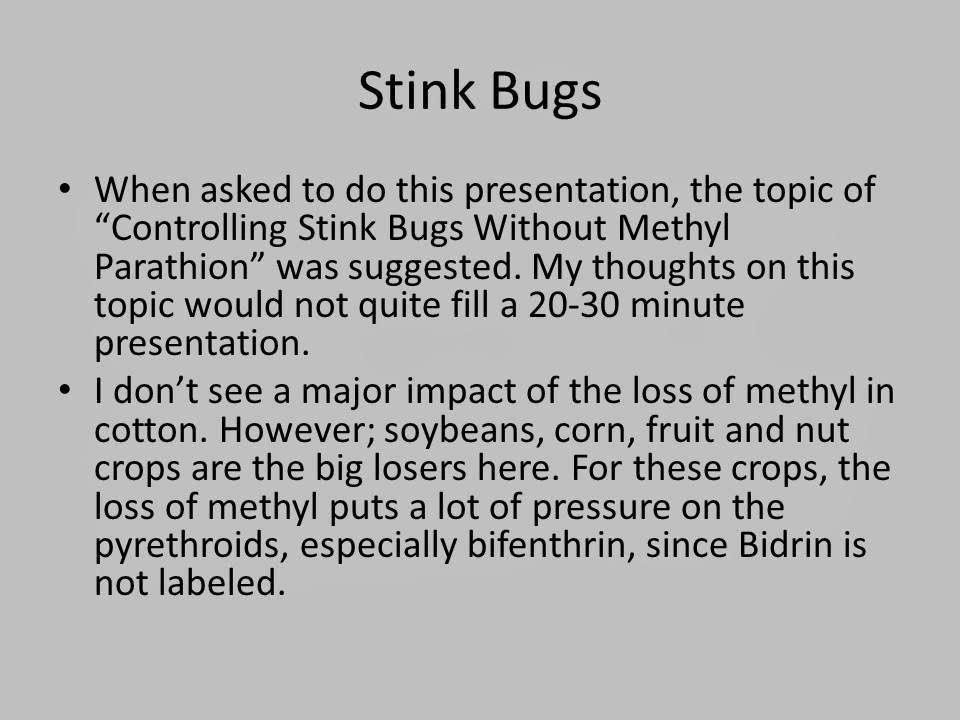
AL/GA Consultant's Meeting Presentation: The Past and Future of Cotton Insect Management and Control
Below is my power point presentation from the Alabama/Georgia Consultants 2014 Meeting.




Wednesday, September 4, 2013
Final Insect Update of the Season
The Alabama row crop insect control season is rapidly winding
down. The few areas that still need attention for a few more weeks are as
follows. We need to protect bolls on June planted cotton from stink bug injury
until the bolls are approximately 25 days old. We still have plenty of time
left in the season to mature small bolls that are present from blooms the last
week of August. On soybeans, stink bugs continue to reproduce and feed on pods.
Late planted, June to early July, soybeans will be susceptible to stink bug
feeding for several more weeks. Stink bug adults will leave other crops when
they mature and seek out late planted soybeans as their last host before heading
for overwintering sites. I expect to see high numbers of stink bugs in many of
these late maturing soybean fields. The good thing is that one application to
economic levels of stink bugs in both cotton and soybeans made now should hold
populations below damaging levels for the remainder of the season. Stink bug
populations currently contain both the brown and southern green species. A high
rate of most pyrethroids on soybeans should give adequate suppression. Kudzu
bug adults are still present in many soybean fields but they are not as
numerous in most fields as they were back a month or so ago. Their numbers
seemed to have peaked in April and May planted beans back in the late June to
early August window.
Overall 2013 has been a light insect year in Alabama for
most species. A summary of what I have observed is the following. For cotton,
thrips were moderate to heavy. However, their movement from wild hosts to
cotton occurred in May instead of April. Therefore, their damage period
coincided with our mid-planting period cotton instead of the earliest planted
as happens most seasons. Plant bugs, aphids and spider mites were very light
overall. Bollworms and tobacco budworms were low to nonexistent, even in fields
of conventional cotton. I have conventional cotton on three research stations
spread across the central and southern areas of Alabama. One had to search very
hard all season to find a single larva or damaged fruit. Stink bugs were the
only cotton insect that occurred at damaging levels in most fields in-season.
In soybeans, Kudzu bugs were extremely heavy in many early
planted soybean fields. This was the first year that many soybean growers have
had to deal with the Kudzu bug. Others will likely have their first experience
in 2014. When all is said and done, I believe we will be able to handle this
insect with one, or at most two, well timed sprays. Late maturing beans will likely
still see a big buildup of stink bugs in coming weeks as other crops mature and
dry down. The foliage feeding complex of green cloverworms, velvetbean
caterpillars and soybean loopers have been very light in 2013. This follows the
most widespread infestations of the past 40 years last season. Podworms have
been very light in soybeans for the past two seasons.
This has been a very unusual year rainfall wise. This may be
the only season during my 41 years here as our Extension Entomologist where we
had too much rain.
Monday, June 24, 2013
Insect and Crop Update for the Week of June 23
After going weeks with light to moderate thrips pressure,
damage was heavy on 4-7 leaf cotton in early June, especially in SW Alabama.
Cotton was growing rapidly but thrips damage on true leaves was showing heavy damage from about the 4th to 7th true leaf. (Peanuts also were taking heavy damage during this same period.)
The thrips window is over now and we need to shift our focus to spider mites, aphids and the plant bug complex which includes tarnished plant bugs, fleahoppers and an occasional clouded plant bug.
Mites are primarily found in the TN Valley region of North Alabama and some treatments were being applied last week.
I noticed the first aphids on April planted cotton in central Alabama last Friday (June 21).
Plant bug numbers (adults) were down last week but nymphs are beginning to appear in our earliest planted cotton (mid-April). I would suggest using a sweep net to sample adults for the next 2-3 weeks, depending on the age of the cotton. As we approach first bloom I would switch to a drop cloth and concentrate on the presence of immature plant bugs.
Also, field men should now be looking at pinhead square set. Fields surveyed on June 21 were setting about 90% of the fruit. However, some plants had up to 30% square loss at that point. I believe you will find that migrating adult tarnished plant bugs will seek out the earliest planted and most lush cotton fields. My thought is that this cotton provides the best shade from the 95 degree temperatures, and is the best host for plant bugs.
While looking for pinhead square set I noticed a number of white eggs, likely tobacco budworms. They would not be a concern now, but in the old days it would have created a real predicament. Spraying for plant bugs during a budworm moth flight would have been expensive and also put the grower on a treatment treadmill for the remainder of the season. Sometimes we forget how well we have it compared to the pre-Bollgard years.
On another insect – a few stink bugs are already present in cotton. Normally we do not worry about stink bugs until about the third week of bloom, when we have bolls that are 10-12 days old. However, when stink bugs are present at bloom they will attack thumb sized bolls as soon as the bloom tag sheds. Any feeding to bolls this size will cause the boll to abort. Therefore, fieldmen need to be alert for adult stink bugs in early bloom cotton as they monitor for plant bugs with a sweepnet. Stink bugs will not damage squares or blooms but will seek out these first small bolls.
Since some of our corn was planted later than desired, stink bugs will likely remain with that host until the post roasting ear stage when the kernels become hard. At that time we may have a large movement into other crops such as cotton, soybeans and peanuts.
One word about Kudzu bugs on soybeans. Numbers of adults are out of site on many of our April planted beans. In fact, adult numbers are beginning to decrease in some fields now but numerous immatures are present, which is the trigger we use to treat the field. Fieldmen who have not experienced this insect may overlook these immatures when they are small. They will be a clear to greenish color and very small after hatching.
Cotton was growing rapidly but thrips damage on true leaves was showing heavy damage from about the 4th to 7th true leaf. (Peanuts also were taking heavy damage during this same period.)
The thrips window is over now and we need to shift our focus to spider mites, aphids and the plant bug complex which includes tarnished plant bugs, fleahoppers and an occasional clouded plant bug.
Mites are primarily found in the TN Valley region of North Alabama and some treatments were being applied last week.
I noticed the first aphids on April planted cotton in central Alabama last Friday (June 21).
Plant bug numbers (adults) were down last week but nymphs are beginning to appear in our earliest planted cotton (mid-April). I would suggest using a sweep net to sample adults for the next 2-3 weeks, depending on the age of the cotton. As we approach first bloom I would switch to a drop cloth and concentrate on the presence of immature plant bugs.
Also, field men should now be looking at pinhead square set. Fields surveyed on June 21 were setting about 90% of the fruit. However, some plants had up to 30% square loss at that point. I believe you will find that migrating adult tarnished plant bugs will seek out the earliest planted and most lush cotton fields. My thought is that this cotton provides the best shade from the 95 degree temperatures, and is the best host for plant bugs.
While looking for pinhead square set I noticed a number of white eggs, likely tobacco budworms. They would not be a concern now, but in the old days it would have created a real predicament. Spraying for plant bugs during a budworm moth flight would have been expensive and also put the grower on a treatment treadmill for the remainder of the season. Sometimes we forget how well we have it compared to the pre-Bollgard years.
On another insect – a few stink bugs are already present in cotton. Normally we do not worry about stink bugs until about the third week of bloom, when we have bolls that are 10-12 days old. However, when stink bugs are present at bloom they will attack thumb sized bolls as soon as the bloom tag sheds. Any feeding to bolls this size will cause the boll to abort. Therefore, fieldmen need to be alert for adult stink bugs in early bloom cotton as they monitor for plant bugs with a sweepnet. Stink bugs will not damage squares or blooms but will seek out these first small bolls.
Since some of our corn was planted later than desired, stink bugs will likely remain with that host until the post roasting ear stage when the kernels become hard. At that time we may have a large movement into other crops such as cotton, soybeans and peanuts.
One word about Kudzu bugs on soybeans. Numbers of adults are out of site on many of our April planted beans. In fact, adult numbers are beginning to decrease in some fields now but numerous immatures are present, which is the trigger we use to treat the field. Fieldmen who have not experienced this insect may overlook these immatures when they are small. They will be a clear to greenish color and very small after hatching.
Monday, June 10, 2013
Insect Update on Cotton and Soybeans
As of 8:45 am Monday, June 10, all is quiet on the insect
front. Rainfall during the past week has given cotton a growth spurt. Youngest cotton
is 3 to 5 true leaves and overall has little thrips injury. Older cotton is at
the 5 to 9 true leaf stage. Many fields are between the thrips injury stage and
the stage where we begin to focus on plant bugs. This window is about 7 to 10
days long. Mid April planted cotton already has 2-3 pinhead or larger squares
and should be scouted for adult plant bugs. No aphids or spider mites have been
reported.
We will be conducting scouting schools in Autaugaville (central AL) and Headland (Wiregrass area of SE AL) this week. In addition to cotton and soybean insects (Kudzu bugs) we will also have presentations on cotton disease and resistant weed management.
Kudzu bug adults are attacking early planted soybeans in the Prattville, Tallassee and Auburn areas. At present our treatment threshold is 5 adults per plant.
We will be conducting scouting schools in Autaugaville (central AL) and Headland (Wiregrass area of SE AL) this week. In addition to cotton and soybean insects (Kudzu bugs) we will also have presentations on cotton disease and resistant weed management.
Kudzu bug adults are attacking early planted soybeans in the Prattville, Tallassee and Auburn areas. At present our treatment threshold is 5 adults per plant.
Monday, August 6, 2012
Update for the Week of August 5
We are now in the home stretch, as far as insect control, in
most fields of April planted cotton. Overall, there are a few things that I
would be on the outlook for this week.
Stink bugs pose the greatest threat to most fields for the remainder of the season. Numbers vary greatly from field to field and in many cases from area to area within fields. For this reason, surveys must be thorough enough to detect the overall situation in each field. A dozen or so bolls will not accurately reflect the true infestation in most instances. Remember to select or sample 10-12 day old (quarter diameter) bolls. First separate out those with external damage from those with no external feeding signs. Second, crush those bolls with external damage and observe for internal injury. Our recommended “dynamic threshold” ranges from 30-50% internal damage early in the blooming period down to 10% during weeks 3-6 of bloom. This low threshold corresponds to the period when a high percentage of the total bolls are being set. Later into the blooming season, which is where many of our fields are now, we can relax our treatment threshold back up to the 30-50% range.
Now onto some other pests:
The mid-to-late July bollworm flight was maybe the lowest in modern times. Bollworms have been almost non-detectable in fields in central, SW and SE Alabama, even in cotton with no genetic technology.
As to tobacco budworms – while at the Wiregrass Research Center (SE Alabama) last week, numerous TBW moths were observed. This matches up with reports from SW Georgia that indicates an extremely high budworm flight going on in that nearby location. This will not be anything of concern for Bt cotton but this could be a very significant event for peanut growers and even soybeans.
No questions were received concerning spider mite control last week. However, I personally observed mites in numerous fields that have not historically had mite infestations. They are present in many fields and their explosion will be greatly influenced by temperature and moisture for the remainder of the season. Growers treating for stink bugs would be wise to select an insecticide that is least likely to help flare mites.
With these thoughts we will end today and get back with another update as conditions change.
Stink bugs pose the greatest threat to most fields for the remainder of the season. Numbers vary greatly from field to field and in many cases from area to area within fields. For this reason, surveys must be thorough enough to detect the overall situation in each field. A dozen or so bolls will not accurately reflect the true infestation in most instances. Remember to select or sample 10-12 day old (quarter diameter) bolls. First separate out those with external damage from those with no external feeding signs. Second, crush those bolls with external damage and observe for internal injury. Our recommended “dynamic threshold” ranges from 30-50% internal damage early in the blooming period down to 10% during weeks 3-6 of bloom. This low threshold corresponds to the period when a high percentage of the total bolls are being set. Later into the blooming season, which is where many of our fields are now, we can relax our treatment threshold back up to the 30-50% range.
Now onto some other pests:
The mid-to-late July bollworm flight was maybe the lowest in modern times. Bollworms have been almost non-detectable in fields in central, SW and SE Alabama, even in cotton with no genetic technology.
As to tobacco budworms – while at the Wiregrass Research Center (SE Alabama) last week, numerous TBW moths were observed. This matches up with reports from SW Georgia that indicates an extremely high budworm flight going on in that nearby location. This will not be anything of concern for Bt cotton but this could be a very significant event for peanut growers and even soybeans.
No questions were received concerning spider mite control last week. However, I personally observed mites in numerous fields that have not historically had mite infestations. They are present in many fields and their explosion will be greatly influenced by temperature and moisture for the remainder of the season. Growers treating for stink bugs would be wise to select an insecticide that is least likely to help flare mites.
With these thoughts we will end today and get back with another update as conditions change.
Monday, July 30, 2012
Update for the week of July 29th
The dominant question last week was concerning spider mite
control. Several calls were received from consultants or agri fieldmen in the
southern part of the state. Their question was not so much what to spray with
(chemical choice) but instead when to spray. Most were scheduling stink bug
sprays within a few days and wanted to know whether to add a miticide or not.
Without seeing the fields, that is a difficult decision to make over the phone.
My thoughts were that it could depend somewhat on how widespread the mites were
in the field, the level of mite infestation and maybe most importantly – what is
the weather outlook for the next 7-10 days.
Mite populations seem to hold steady in good rainfall patterns but explode during hot-dry weather. Even though we have had scattered thunderstorms for the past several weeks, there are many places where no rainfall has occurred. Last week was hot, mid 90’s or higher all week, so mites likely increased in number.
My suggestion would be to go ahead and treat mites if the weather outlook is for hot dry weather for the next 5-7 days. Most of our mites controls this season have been with abamectin (Agri Mek) at 8 oz/ac and results have been good.
Stink bug populations are still hanging around, in low numbers in many fields. However, from personal experience in a plant bug trial area in central Alabama that is located adjacent to corn, stink bug numbers have exploded in the past two weeks. Both brown and southern green species are well above the threshold level on the corn-cotton borders. Where cotton yields are promising and quarter diameter 10 day old bolls are still developing, stink bugs should be watched closely and controlled when above threshold. Cotton is at various stages now so our “dynamic threshold” would depend on where we are in the blooming-boll development cycle. Remember that 10% is our suggested threshold from weeks 3 through about 6 of bloom.
One other call was received last week concerning one or more fields in Baldwin County (Gulf Coast) infested with damaging levels of the garden fleahopper. We had several fields in recent seasons with this pest in the Mobile county area. The GFH seems to be primarily a foliage feeder but can damage every leaf in a field.
As of this date the bollworm/budworm complex is almost non-detectable, even in cotton with no caterpillar technology.
Mite populations seem to hold steady in good rainfall patterns but explode during hot-dry weather. Even though we have had scattered thunderstorms for the past several weeks, there are many places where no rainfall has occurred. Last week was hot, mid 90’s or higher all week, so mites likely increased in number.
My suggestion would be to go ahead and treat mites if the weather outlook is for hot dry weather for the next 5-7 days. Most of our mites controls this season have been with abamectin (Agri Mek) at 8 oz/ac and results have been good.
Stink bug populations are still hanging around, in low numbers in many fields. However, from personal experience in a plant bug trial area in central Alabama that is located adjacent to corn, stink bug numbers have exploded in the past two weeks. Both brown and southern green species are well above the threshold level on the corn-cotton borders. Where cotton yields are promising and quarter diameter 10 day old bolls are still developing, stink bugs should be watched closely and controlled when above threshold. Cotton is at various stages now so our “dynamic threshold” would depend on where we are in the blooming-boll development cycle. Remember that 10% is our suggested threshold from weeks 3 through about 6 of bloom.
One other call was received last week concerning one or more fields in Baldwin County (Gulf Coast) infested with damaging levels of the garden fleahopper. We had several fields in recent seasons with this pest in the Mobile county area. The GFH seems to be primarily a foliage feeder but can damage every leaf in a field.
As of this date the bollworm/budworm complex is almost non-detectable, even in cotton with no caterpillar technology.
Tuesday, July 24, 2012
Update for the week of July 22nd
The past 7-10 days has been about as quiet insect wise as I
ever remember for that time of the season.
Insect wise, we still have a few scattered Tarnished Plant Bug adults and a few immatures in some unsprayed fields – but I am not aware of a single field that has economic or treatable levels. In many instances where I have actually monitored fields, I found that part of the plant bug population is the clouded plant bug species. This species has been present in some fields in Alabama for most of the month of July.
Spider mites are still hanging around but have not exploded in recent weeks. The weather in the form of multiple thunderstorms appears to have slowed mites. Speaking of weather, some areas of the state have received multiple rain events of one to two inches or more while others have received only tenths a few times. Cotton ranges from as good as it has ever looked to knee high and blooming out the top depending on the planting date and the amount of rainfall received. In general, the earlier planted cotton that was stressed due to the heat and drought in May and June offers the least yield potential.
Back to insects now – a few stink bugs, mostly brown, are present in most fields. However, the numbers do not reflect the level we anticipated following a mild winter and the number seen on wheat at harvest time. It appears that the hot dry weather last month took its toll on stink bugs also. Boll damage to stink bugs is less than 10% in many fields. Cotton maturity ranges from the third week of bloom on late planted cotton to probably the sixth or seventh week of bloom on earlier planted fields.
Since we are at least at the third week of bloom, growers might want to consider a clean of spray for subthreshold levels of plant bugs and sink bugs in fields that have not received a foliar insecticide application yet in 2012.
This used to be the time we could also catch some escaped bollworms with this clean up spray. However, at this point, the bollworm flight statewide is very low and escaped worms are almost non detectable. Still the bug complex alone could help justify a clean up spray.
This is the way we see it on July 24, we will be back with an update as the season unfolds and conditions change.
Insect wise, we still have a few scattered Tarnished Plant Bug adults and a few immatures in some unsprayed fields – but I am not aware of a single field that has economic or treatable levels. In many instances where I have actually monitored fields, I found that part of the plant bug population is the clouded plant bug species. This species has been present in some fields in Alabama for most of the month of July.
Spider mites are still hanging around but have not exploded in recent weeks. The weather in the form of multiple thunderstorms appears to have slowed mites. Speaking of weather, some areas of the state have received multiple rain events of one to two inches or more while others have received only tenths a few times. Cotton ranges from as good as it has ever looked to knee high and blooming out the top depending on the planting date and the amount of rainfall received. In general, the earlier planted cotton that was stressed due to the heat and drought in May and June offers the least yield potential.
Back to insects now – a few stink bugs, mostly brown, are present in most fields. However, the numbers do not reflect the level we anticipated following a mild winter and the number seen on wheat at harvest time. It appears that the hot dry weather last month took its toll on stink bugs also. Boll damage to stink bugs is less than 10% in many fields. Cotton maturity ranges from the third week of bloom on late planted cotton to probably the sixth or seventh week of bloom on earlier planted fields.
Since we are at least at the third week of bloom, growers might want to consider a clean of spray for subthreshold levels of plant bugs and sink bugs in fields that have not received a foliar insecticide application yet in 2012.
This used to be the time we could also catch some escaped bollworms with this clean up spray. However, at this point, the bollworm flight statewide is very low and escaped worms are almost non detectable. Still the bug complex alone could help justify a clean up spray.
This is the way we see it on July 24, we will be back with an update as the season unfolds and conditions change.
Monday, July 9, 2012
Insect and Weather Update for the week of July 9th 2012
The past 10
days have been characterized by heat, drought, scattered thunderstorms, aphids,
and in some cases spider mite decisions. Some areas have received one or more
rainfall events of 1 to 3 inches or more while others are still suffering
extreme drought. Some of these storms have brought high winds, downed trees,
demolished buildings and hail.
Insects have been rather quiet overall. Many field men have made aphid treatment decisions with significant acres treated. In at least one incidence, both aphids and mites were at treatment levels. Other more sporadic fields have needed adult tarnished plant bug controls. In the majority of cases the plant bug population has now shifted to immatures. In these cases field men need to switch from sweep nets to drop cloths to quantify these immature plant bugs. Two or three immatures per drop could be considered a threshold level requiring treatments, especially if “dirty” blooms are present. Pinhead square retention is no longer the best way to look for plant bug damage since they spend more time down in the canopy feeding on larger squares (which later become dirty blooms).
I have not had any calls yet, but field men in the southern areas of the state need to pay attention to stink bugs since our oldest fields are now at week three, four or more of bloom. Weeks three through six of bloom is when stink bugs are most damaging. A good threshold for treatment during this period is 10-15% internal damage to quarter diameter (still soft) 10-12 day old bolls. Look for brown areas near the seed and warts on the inside boll wall where stink bugs have penetrated in search of a protection source in the form of developing seed. If the population of stink bugs is primarily the southern green species then we have choices of both pyrethroid and phosphates. However, as most likely the case, the population may be predominately brown stink bugs. Here we would need a phosphate such as Bidrin or either a high rate of bifenthrin and get decent suppression.
Reports were just received of an increase of small larvae on peanuts in south-central Alabama. My guess would be that they are tobacco budworms. By July 15, newly hatched larvae will more likely be corn earworms.
Insects have been rather quiet overall. Many field men have made aphid treatment decisions with significant acres treated. In at least one incidence, both aphids and mites were at treatment levels. Other more sporadic fields have needed adult tarnished plant bug controls. In the majority of cases the plant bug population has now shifted to immatures. In these cases field men need to switch from sweep nets to drop cloths to quantify these immature plant bugs. Two or three immatures per drop could be considered a threshold level requiring treatments, especially if “dirty” blooms are present. Pinhead square retention is no longer the best way to look for plant bug damage since they spend more time down in the canopy feeding on larger squares (which later become dirty blooms).
I have not had any calls yet, but field men in the southern areas of the state need to pay attention to stink bugs since our oldest fields are now at week three, four or more of bloom. Weeks three through six of bloom is when stink bugs are most damaging. A good threshold for treatment during this period is 10-15% internal damage to quarter diameter (still soft) 10-12 day old bolls. Look for brown areas near the seed and warts on the inside boll wall where stink bugs have penetrated in search of a protection source in the form of developing seed. If the population of stink bugs is primarily the southern green species then we have choices of both pyrethroid and phosphates. However, as most likely the case, the population may be predominately brown stink bugs. Here we would need a phosphate such as Bidrin or either a high rate of bifenthrin and get decent suppression.
Reports were just received of an increase of small larvae on peanuts in south-central Alabama. My guess would be that they are tobacco budworms. By July 15, newly hatched larvae will more likely be corn earworms.
Thursday, May 17, 2012
Abundant Numbers of Thrips in Seedling Cotton Requiring Foliar Applications Across North Alabama
Many cotton
acres in north Alabama are being treated for thrips as large numbers move from
grass to cotton plants in the first to second true leaf stage. Thrips collected
from a cotton field in Lawrence county on May 15 were mainly Tobacco thrips (
Frankliniella fusca) and Flower thrips (Frankliniella tritici) (usually called
Eastern flower thrips). Soybean thrips (Neohydatothrips variabolis) and Western
flower thrips (Frankliniella occidentalis) were also present but in much lower
numbers. However, the proportion of each species in other fields could be
different. Pyrethroids and organophosphates are the primary classes of
chemistry being applied this week for thrips control in cotton. Spider mites
are present in many fields and the foliar applications of these two types of
chemicals for thrips may flare spider mites and farmers and consultants should
monitor fields closely. Foliar chemicals for thrips are frequently being
applied in a tank mix with a herbicide and growers/consultants should read the
herbicide label carefully to insure that the insecticide and herbicide can be
tank mixed. Adverse interactions between some tank mixed insecticides and
herbicides can result in crop injury.
Written By Tim Reed and Barry Freeman, Extension Entomologists.
Written By Tim Reed and Barry Freeman, Extension Entomologists.
Monday, June 27, 2011
Tarnished Plant Bugs Threatening Cotton Yields
Tim Reed, Extension Entomologist
June 21, 2011
Control measures for tarnished plant bugs (TPB’s) in the oldest cotton fields in north Alabama began two weeks ago and initial applications continue to be applied to later planted fields. Consultants report TPB pressure to be higher than normal than at this time last year and there is concern that some fields, especially older fields may require two TPB treatments. The cooler, wetter weather we are having this week in parts of Alabama will be favorable to TPB’s. The longer TPB treatments are postponed the more eggs are deposited by adult TPB’s which result in higher numbers of immature TPB’s present in late June and July. One consultant reports that TPB’s can presently be collected in a sweep net at any time of the day in north Alabama cotton fields but they tend to be more abundant on field edges. Some cotton fields in Montgomery county this week are also suffering 20% (Bt cotton threshold) or better pin head square loss due primarily to TPB damage and there could be control measures initiated in this central Alabama county this week. TPB’s are a much more serious pest for conventional cotton producers than for Bt cotton growers since all available chemicals that control adult plant bugs also significantly reduce beneficial insects/spiders. This increases the chances of a severe tobacco budworm infestation in the last half of June. Conventional cotton growers have a difficult time deciding on whether or not to spray for adult plant bugs in mid-June when they know it will be expensive to “fight” worms. Dry weather makes the decision even more difficult. Mississippi entomologists are reporting higher than normal numbers of tobacco budworm moths being collected in pheromone traps and budworm moths are now depositing low numbers of eggs on cotton in Montgomery county. Another concern for all cotton producers is the fear of spider mite populations increasing after TPB applications. Spider mites tend to appear in the same areas each year. Thus far a few north Alabama cotton fields have been treated with bifenthrin to help slow spider mites. Serious spider mite problems will require more expensive chemistry and consultants hope disease will take out the spider mites before more costly chemicals are required.
Monday, March 14, 2011
Cotton Insect Management, 2011
Points for Discussion:
1. Low Input System - Conventional vs. Technology
2. Evolution of Bt Cotton - Various Genes Involved
How do they compare and what is in the future?
3. Phase Out of Temik
What will be the greatest impact?
4. Stink Bug Research Towards a More Rapid Survey Technique
Factors that influence external vs. internal stink bug boll damage.
5. New Damaging Insects
Plataspid (Kudzu) Bug
Brown Marmorated Stink Bug
Red-Banded Stink Bug
Phase out of Temik:
“EPA and Bayer CropScience, the manufacturer, have reached an agreement to end use of the pesticide aldicarb in the United States.” EPA release October 2010
Remaining uses: During the phase-out, aldicarb use may continue on cotton and peanuts with use-rate reductions and rural well setbacks.
Today, I would like to comment on another benefit of Temik – that being spider mite suppression. In the long haul this may be the most significant loss or impact from the phase out of Temik.
As I have commented to growers in our winter production meetings, there is one advantage of being old and that is you have “seen more history”. In my case I can remember what a major problem spider mites were on cotton in the 1950’s and 60’s. I have seen entire fields in the Tennessee Valley region of Alabama completely defoliated prior to maturity due to spider mite damage. No effective foliar controls were available. Beginning about 1970, when Temik entered the market, spider mites became a relative insignificant pest of cotton for about 30 plus years. Beginning with the movement to seed treatments, mites have become a significant player again. Not in all fields or all years. However, when conditions are conducive, mites can be very economic again. Newer products are now available for foliar control but they do not give extended suppression and most are relatively expensive on a per acre basis. I am not sure that we have anything today that has the mite suppression activity of Temik. Therefore, in the long run, the loss of Temik may leave its greatest impact on mite control. Time will tell.
1. Low Input System - Conventional vs. Technology
2. Evolution of Bt Cotton - Various Genes Involved
How do they compare and what is in the future?
3. Phase Out of Temik
What will be the greatest impact?
4. Stink Bug Research Towards a More Rapid Survey Technique
Factors that influence external vs. internal stink bug boll damage.
5. New Damaging Insects
Plataspid (Kudzu) Bug
Brown Marmorated Stink Bug
Red-Banded Stink Bug
Phase out of Temik:
“EPA and Bayer CropScience, the manufacturer, have reached an agreement to end use of the pesticide aldicarb in the United States.” EPA release October 2010
Remaining uses: During the phase-out, aldicarb use may continue on cotton and peanuts with use-rate reductions and rural well setbacks.
- Registered in 1970
- Production ends by December 31st, 2014
- Distribution and sales end by December 31st, 2016
- Use ends by August 31st, 2018
Impact in cotton production:
- early season insects
- nematodes
- **suppression of spider mites
Update and Comments on Temik Phase-Out:
A two-week temporary restraining order affecting the production of a key intermediate used in the production of Temik brand aldicarb was issued February 10 by a federal judge in West Virginia. This order was issued in response to a lawsuit brought about by 16 residents who reside near the production plant. This restraining order was later extended until March 28. Bottom line is the supply of Temik for the 2011 season will be limited.The point I wish to focus on today is the long term impact of the loss of Temik in cotton insect management. We all recognized the role Temik played in early season insect control, particularly thrips. However, in recent years we have learned how to better utilize seed treatments, supplemented with foliar sprays as needed.
In addition, growers who continued to utilize Temik were often also benefiting from its nematicideal properties. The loss of Temik will leave a major void in nematode management.Today, I would like to comment on another benefit of Temik – that being spider mite suppression. In the long haul this may be the most significant loss or impact from the phase out of Temik.
As I have commented to growers in our winter production meetings, there is one advantage of being old and that is you have “seen more history”. In my case I can remember what a major problem spider mites were on cotton in the 1950’s and 60’s. I have seen entire fields in the Tennessee Valley region of Alabama completely defoliated prior to maturity due to spider mite damage. No effective foliar controls were available. Beginning about 1970, when Temik entered the market, spider mites became a relative insignificant pest of cotton for about 30 plus years. Beginning with the movement to seed treatments, mites have become a significant player again. Not in all fields or all years. However, when conditions are conducive, mites can be very economic again. Newer products are now available for foliar control but they do not give extended suppression and most are relatively expensive on a per acre basis. I am not sure that we have anything today that has the mite suppression activity of Temik. Therefore, in the long run, the loss of Temik may leave its greatest impact on mite control. Time will tell.
Tuesday, September 28, 2010
Cotton Insect Loss Estimates Made
2010 was one of the lightest insect years on record. Loss estimates range from a total of 5.2% of yield in central and south Alabama to 3.6% in the Tennessee Valley region. Most of these losses were attributed to one insect (pest) in each region. For the southern region it was the stink bug, predominately the brown species (3.5%), and for the north it was spider mites (2.3%). Other insects that caused measurable losses were the bollworm (lowest in 38 years), plant bug, and thrips.
Tuesday, June 22, 2010
Spider mites, tarnished plant bugs, tobacco budworms, stink bugs, and yellow striped armyworms observed
Cotton 6/21/2010 - Spider mites were reported infesting select fields in Talladega county today. This is the second call I have had concerning mites on cotton in the past week. This problem could spread in coming weeks with the hot weather. Thunderstorms rumbled through parts of the state on Saturday. But, some areas remain dry with intense heat.
I have received no new reports of tarnished plant bug (TPB) activity. Hopefully, this heavy migration from wild hosts will be of short duration. Fields that were treated for TPBs in southwest Alabama are clean this week with high square retention. Unsprayed fields have some level of plant bugs left but they do not appear to be causing greater than 20% square loss.
Today, I collected early instar tobacco budworm larvae from tobacco at the Gulf Coast Research Center. Tobacco is being used as a sentinel crop at three sites to monitor budworm activity (Prattville, Fairhope, and Headland, AL). Based on observations, it appears that some level of budworm egg lay has been going on for two or more weeks. Growers with conventional cotton should be very selective in spraying for any other insect during this budworm flight. Keep beneficials in conventional cotton as long as possible. Hopefully, up to July 15 in central Alabama and July 20 in central Alabama.
One insect that may make it difficult to leave uncontrolled after the first week of bloom is the stink bug. Numerous brown stink bugs (BSB) can be found in many fields at present. They will not damage pre-bloom cotton but as soon as the bloom drops they will attack the thumb sized boll causing abortion from the plant. I am seeing a level of BSBs that will require controls in many fields by the second week of bloom. It does not appear that these BSB are moving to corn or other hosts, but instead are just waiting for the first small bolls. In fact, when those in corn begin looking for a new home, we likely will have many move into cotton.
Yellow striped armyworms, in low numbers, were observed in numerous BGII fields in Monroe county today.
On other crops - tobacco budworms, fall armyworms and yellow striped armyworms were reported feeding as foliage feeders on peanuts in Monroe county (southwest AL) today. Numbers were low (one per 4-5 row feet) in many fields but a few fields had numbers approaching concern and will be watched closely during the next 7-10 days. The average peanut field has about six inches of foliage at this time.
I have received no new reports of tarnished plant bug (TPB) activity. Hopefully, this heavy migration from wild hosts will be of short duration. Fields that were treated for TPBs in southwest Alabama are clean this week with high square retention. Unsprayed fields have some level of plant bugs left but they do not appear to be causing greater than 20% square loss.
Today, I collected early instar tobacco budworm larvae from tobacco at the Gulf Coast Research Center. Tobacco is being used as a sentinel crop at three sites to monitor budworm activity (Prattville, Fairhope, and Headland, AL). Based on observations, it appears that some level of budworm egg lay has been going on for two or more weeks. Growers with conventional cotton should be very selective in spraying for any other insect during this budworm flight. Keep beneficials in conventional cotton as long as possible. Hopefully, up to July 15 in central Alabama and July 20 in central Alabama.
One insect that may make it difficult to leave uncontrolled after the first week of bloom is the stink bug. Numerous brown stink bugs (BSB) can be found in many fields at present. They will not damage pre-bloom cotton but as soon as the bloom drops they will attack the thumb sized boll causing abortion from the plant. I am seeing a level of BSBs that will require controls in many fields by the second week of bloom. It does not appear that these BSB are moving to corn or other hosts, but instead are just waiting for the first small bolls. In fact, when those in corn begin looking for a new home, we likely will have many move into cotton.
Yellow striped armyworms, in low numbers, were observed in numerous BGII fields in Monroe county today.
On other crops - tobacco budworms, fall armyworms and yellow striped armyworms were reported feeding as foliage feeders on peanuts in Monroe county (southwest AL) today. Numbers were low (one per 4-5 row feet) in many fields but a few fields had numbers approaching concern and will be watched closely during the next 7-10 days. The average peanut field has about six inches of foliage at this time.
Subscribe to:
Posts (Atom)